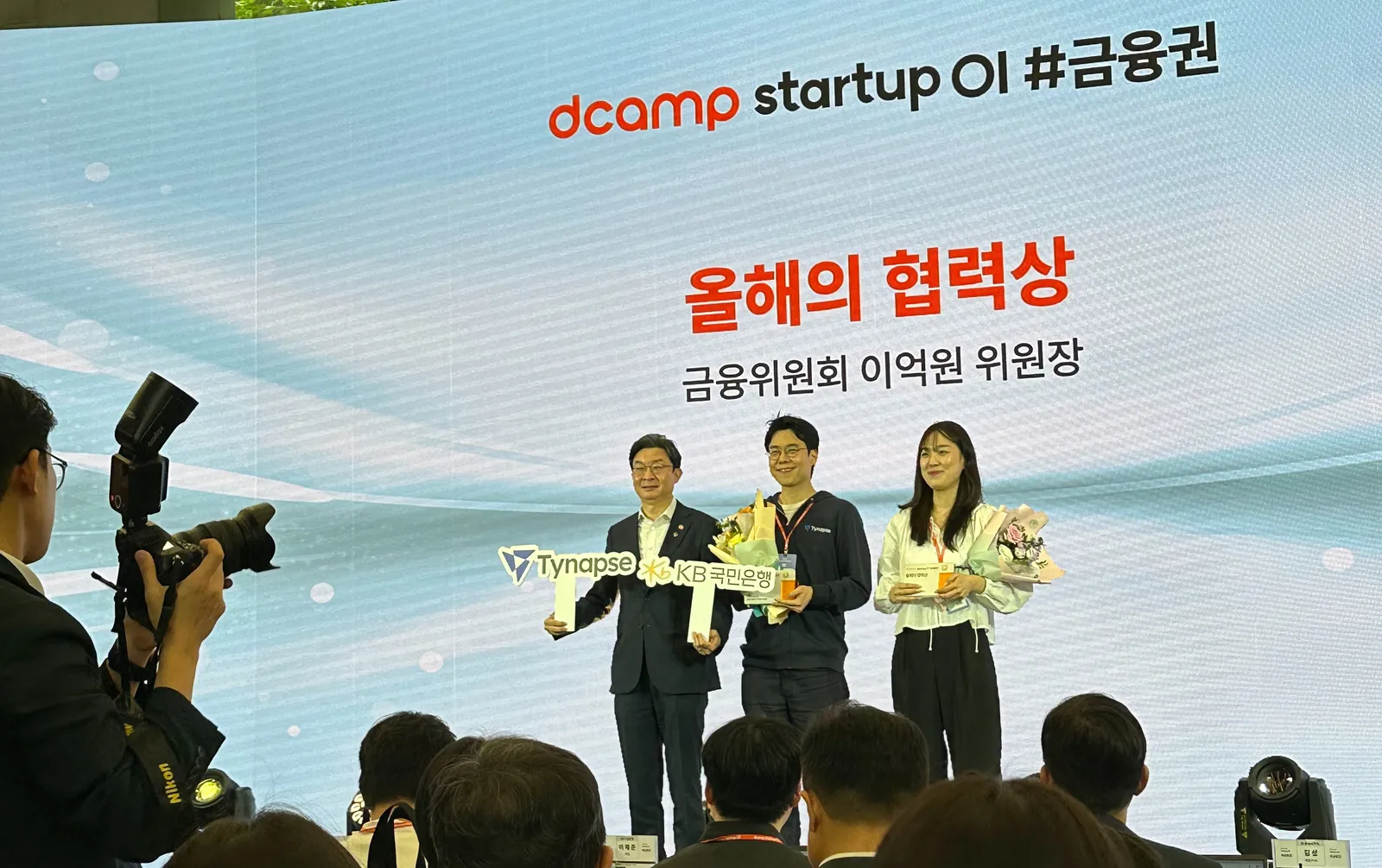
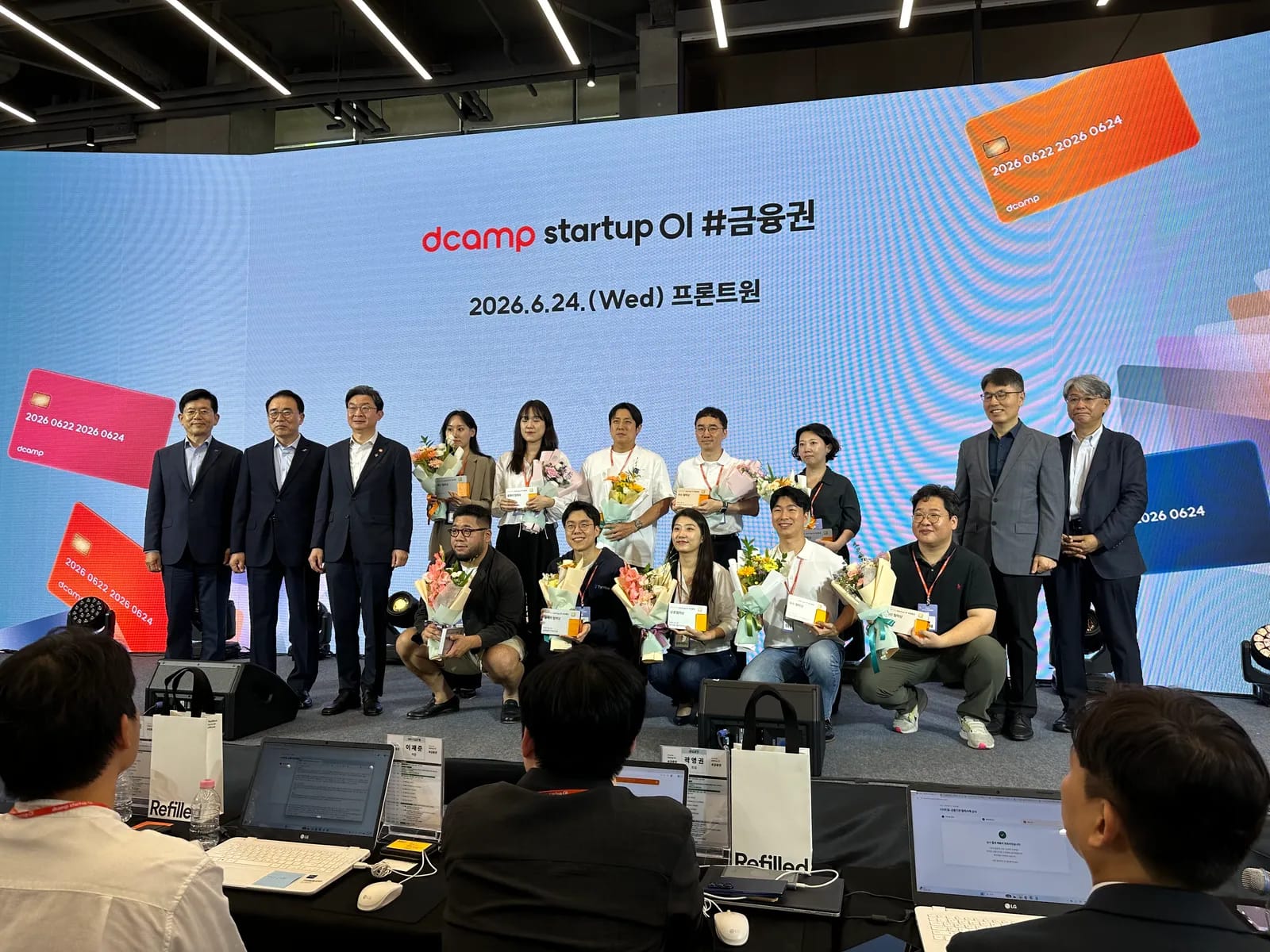
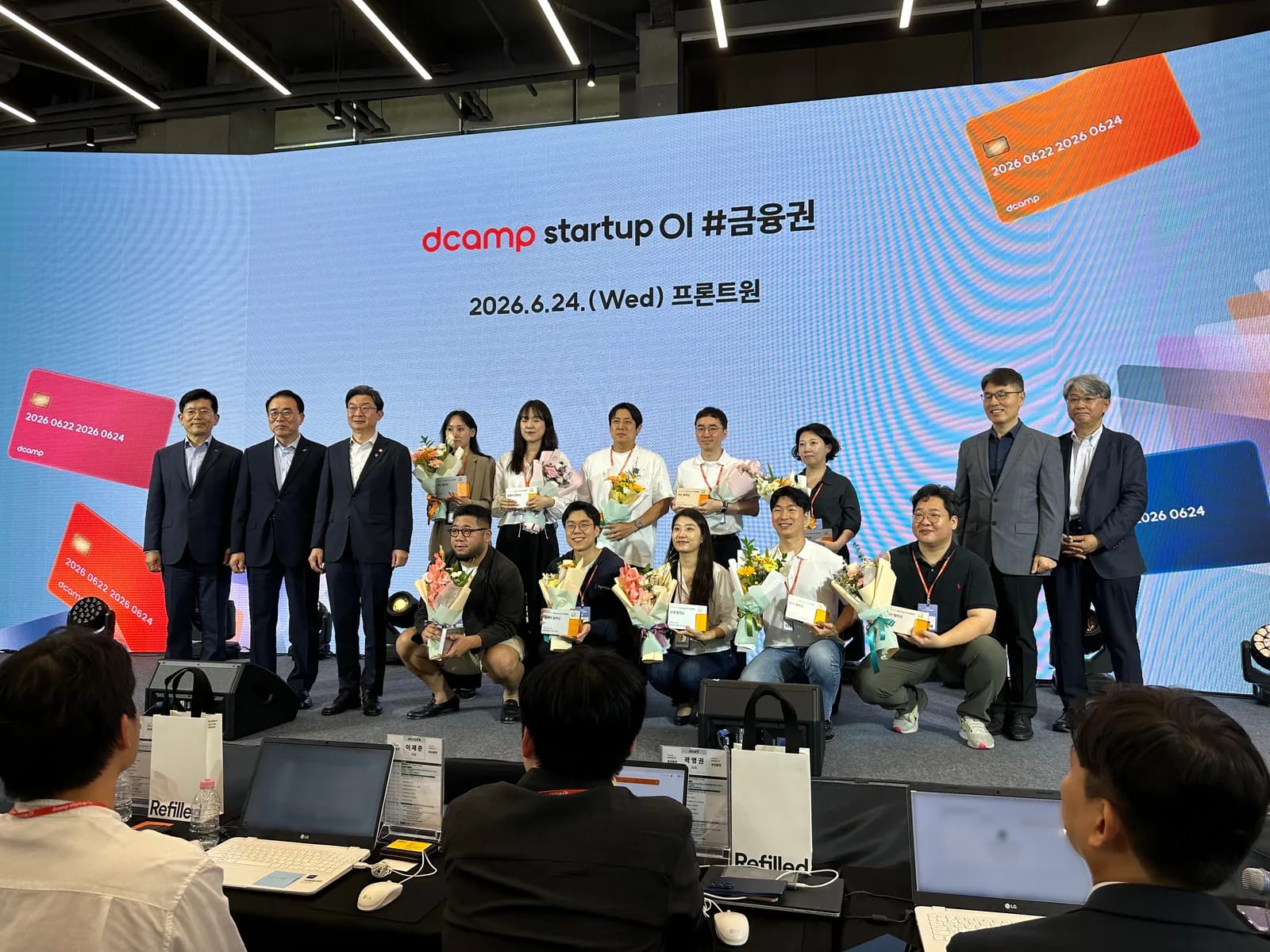
Tynapse, a company that verifies the reliability of AI-generated answers, has won the FSC Chairman’s Award, the top “Partnership of the Year” honor at Startup OI #Finance, together with KB Kookmin Bank.
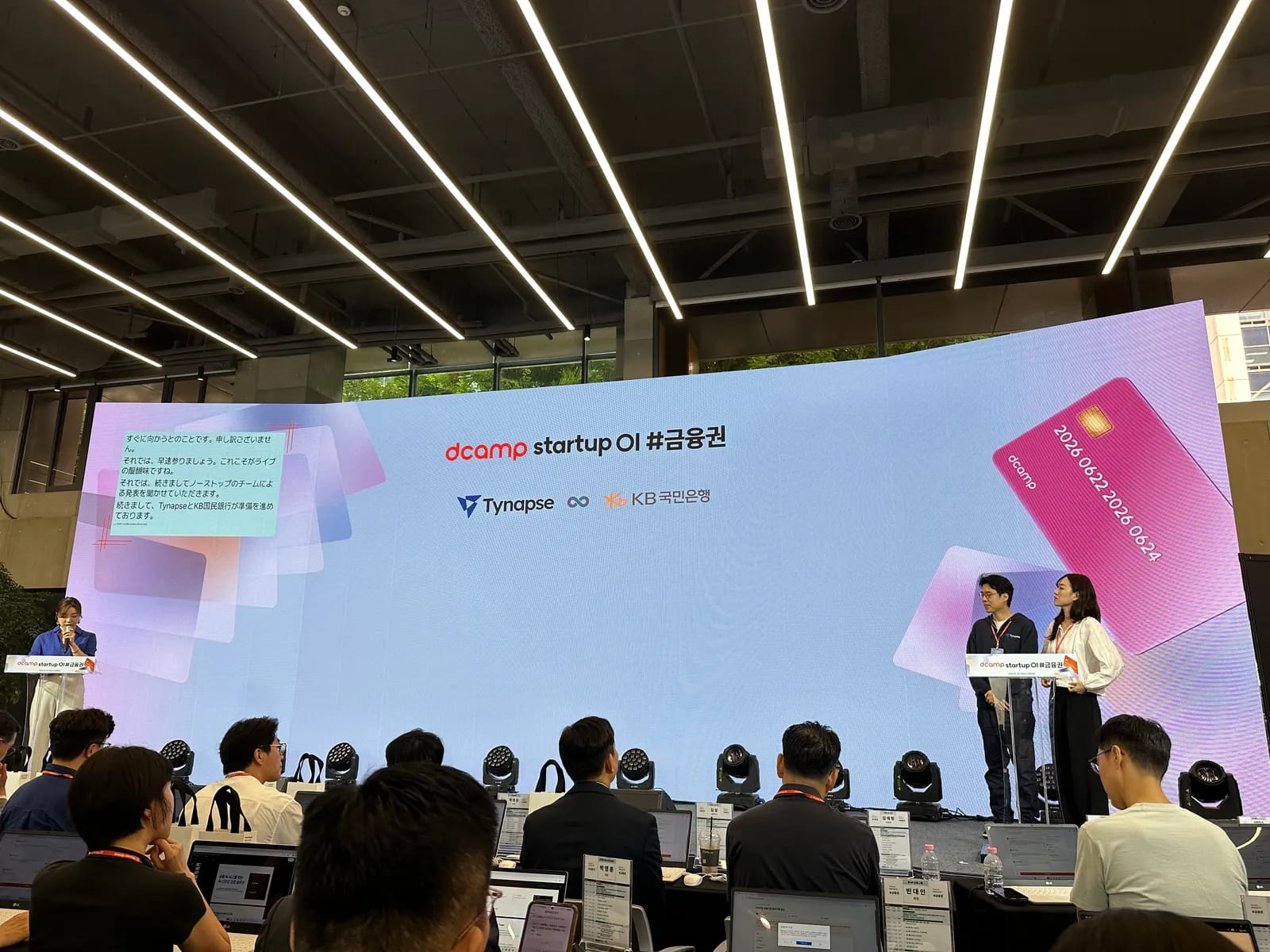
Startup OI is a financial-sector open innovation program hosted by D.CAMP and the Korea Fintech Center, created to surface and share real collaboration outcomes between financial institutions and startups. Out of 44 collaboration cases submitted through May, five companies advanced to the finals after a preliminary review, and Tynapse presented its generative-AI answer-verification collaboration with KB Kookmin Bank.
This award matters because it goes beyond a simple technical proof of concept. It shows what financial institutions actually need in order to put generative AI to work in real operations.
The next challenge for financial AI is the accurate answer
The use of generative AI in finance is expanding fast. Across internal work support, product consultation, credit-review assistance, and foreign exchange, deposit, and retirement-pension operations, AI is becoming a tool that raises employee productivity.
But financial AI is not an ordinary chatbot. A single answer can be used in a customer consultation, and a wrong piece of guidance can lead to an actual transaction correction or customer inconvenience. With financial products, regulations, and internal work standards in particular, even a small difference in wording can become an important basis for judgment.
So the core question in operating financial AI is not “can the AI generate an answer,” but “can we trust that answer enough to use it in our work.”
Whether the AI produced content with no basis, whether it matches the relevant regulations, whether it violates internal policy, and whether a dangerous answer can be blocked before it reaches the customer are all becoming critical.
The AI answer-verification system built with KB Kookmin Bank
At KB Kookmin Bank, about 7,000 employees use its generative-AI portal each month, and the bank runs AI-based work support across 10 business areas, including corporate credit, retail credit, deposits, foreign exchange, retirement pensions, and anti-money laundering.
As AI use expanded, the key challenge also became clear. An AI-generated answer might differ from frontline work standards, misinterpret a relevant regulation, or lead to inaccurate information during a consultation.
Tynapse and KB Kookmin Bank built an AI answer-verification system so that these problems can be found and blocked before they are ever used in a customer consultation.
Across five business areas, including corporate credit, the two partners worked with frontline teams to build ground-truth datasets and a system that can automatically evaluate AI answers. The verification system automatically checks the basis for an answer and the relevant regulations, and when it finds a mismatch, it blocks that answer. It also keeps the reasoning and evaluation logs together so that after-the-fact audits are possible.
Tynapse improved the Judge model used for answer verification six times to raise its accuracy, and by building ground-truth data and advancing the model in parallel, it pushed the evaluation score up to around 90 points.
Why an AI Trust Layer is needed
For generative AI to enter the real operations of a financial institution, a simple security filter is not enough.
On what basis the AI answered, whether it conflicts with work regulations, whether a dangerous answer can be stopped before it reaches the customer, and whether the reasoning can be re-examined when something goes wrong all have to be managed together. Tynapse defines this as the AI Trust Layer.
The AI Trust Layer is a trust layer that operates between the AI model and real business systems. It verifies the answers and actions the AI generates in real time, and routes them to pass, block, revise, or human review according to the company’s policies and regulations.
In finance, the following capabilities matter in particular.
- Verifying that an AI answer matches its source documents
- Checking that it does not violate internal work standards and financial regulations
- Blocking inaccurate or exaggerated answers before they reach the customer
- Keeping every decision step and its basis in logs for use in audits and internal controls
To use AI more, you have to be able to control AI better. Tynapse is building the technology that handles this moment of control in real time.
The direction of financial AX: from security that blocks to trust that enables
Recently in finance, the conversation about using AI and improving security regulations is moving forward together. The easing of network separation rules, the wider use of cloud and SaaS, the revision of the financial-sector AI guideline, and the enforcement of the AI Basic Act all point in the same direction.
Finance, too, needs to use AI more actively. At the same time, that use has to be explainable, controllable, and auditable.
The core of financial AX is now no longer simply adopting AI. It is the operating system that makes AI work safely inside real operations.
Adopting a good model alone is not enough. You have to be able to verify the answers AI produces, block dangerous answers, keep the reasoning, and operate it according to each company’s policy.
This collaboration between Tynapse and KB Kookmin Bank shows the trust infrastructure that financial generative AI needs in order to move beyond PoC and into real operational use.
What we protect is not data, but customers
At this presentation, Tynapse CEO Minseung Kang put it this way.
What we protect is not data, but customers.
The purpose of financial AI is not using AI for its own sake. It is to enable more accurate and safer work, and to build financial services that customers can trust.
Tynapse is building an AI Trust Layer that provides answer-reliability verification, policy-based judgment, audit logs, and operational monitoring so that generative AI can be used safely in the real working environments of financial institutions.
The more work AI takes on, the more important the technology that lets us trust and use AI becomes. This award matters because Tynapse proved the need for financial AI trust infrastructure through a real collaboration outcome.
Going forward, Tynapse will keep advancing, together with financial institutions, not security that blocks AI, but trust technology that lets AI be used responsibly.