
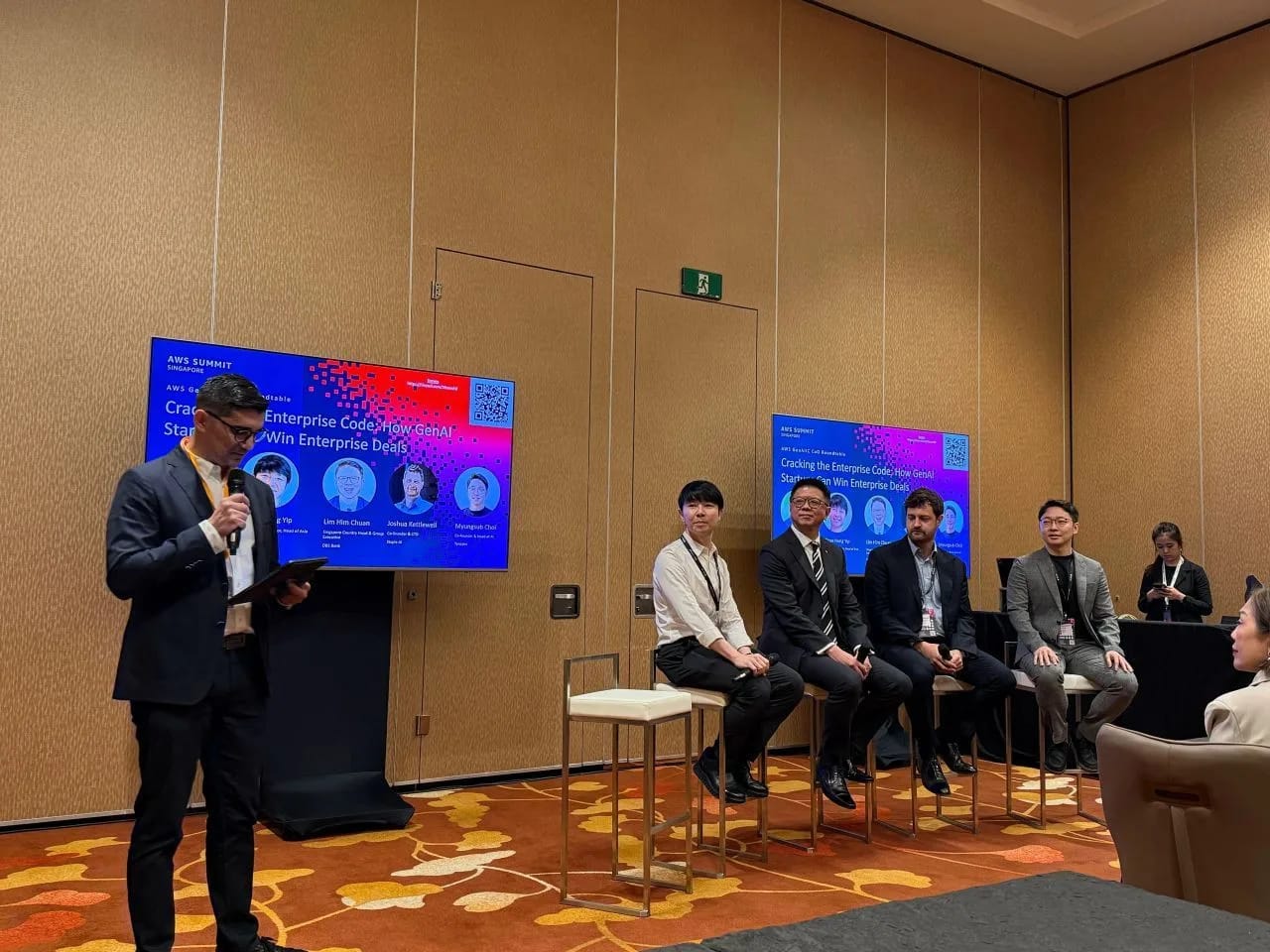
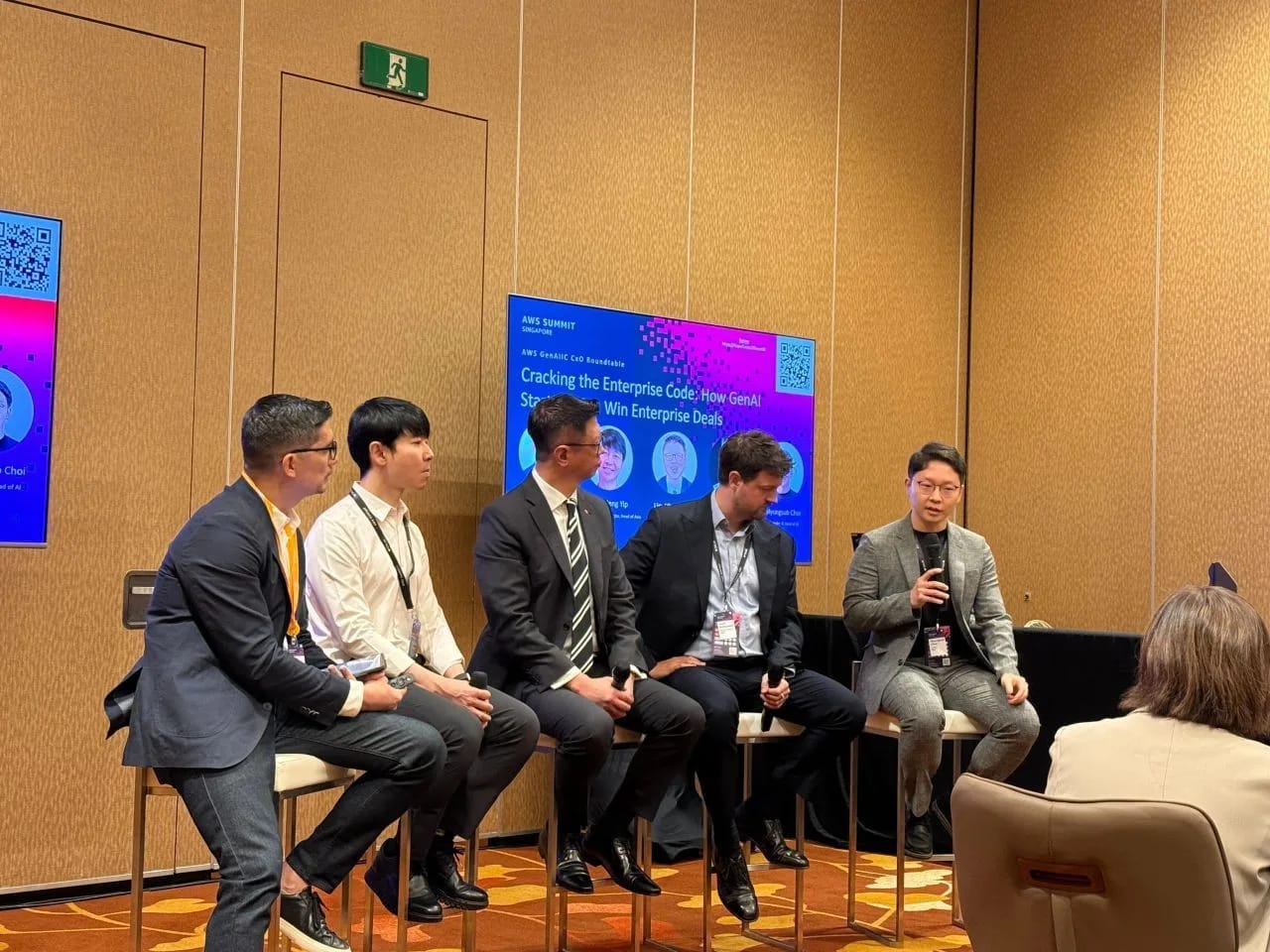
On May 7, Tynapse Head of AI Myungsub Choi joined a panel at the GenAIIC CXO Roundtable, a side event of AWS Summit Singapore. The session, "Cracking the Enterprise Code: How GenAI Startups Can Win Enterprise Deals," focused on how generative AI startups can enter and scale into the enterprise market.
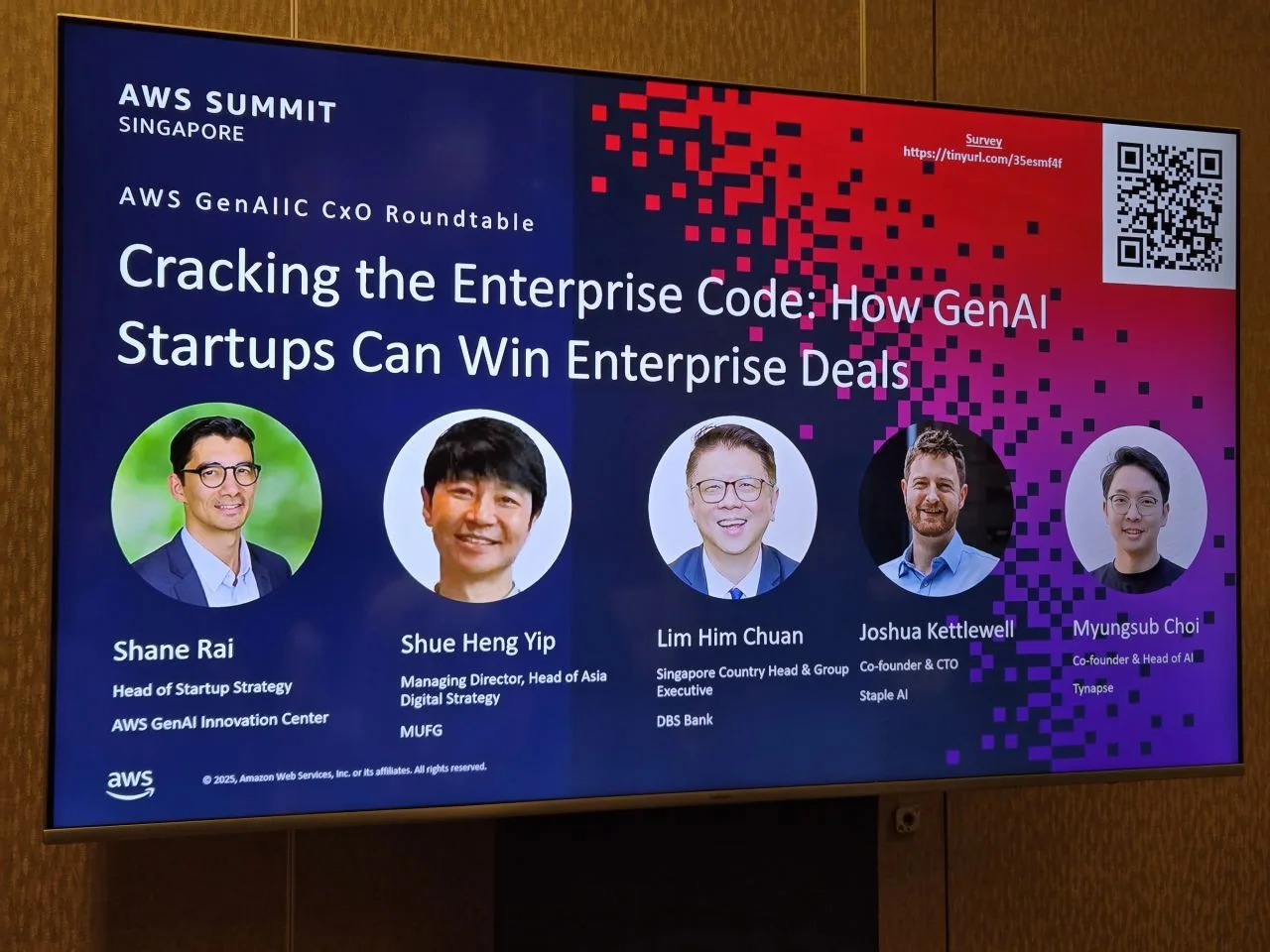
The session was moderated by Shane Rai, Head of Startup Strategy at the AWS GenAI Innovation Center, with panelists including Shue Heng Yip, Head of Asia Digital Strategy at MUFG; Lim Him Chuan, Singapore Country Head & Group Executive at DBS Bank; and Joshua Kettlewell, Co-founder & CTO of Staple AI, all leaders from global financial institutions and enterprise AI.
Three insights from the roundtable
The messages that resonated most with Tynapse:
First, enterprise customers are no longer looking for PoCs. What they want is a partner who can scale with them through the constraints of geography, regulation and real-world operations. Decisions are now anchored not on one-off validation, but on reliability and scalability in production.
Second, AI risk does not arrive only as sudden system failure. The more dangerous form of risk in real operating environments is the slow accumulation of small errors, hallucinations and policy gaps that quietly erode the system over time. This kind of risk cannot be caught by point-in-time model evaluation. It requires continuous verification and tracing at runtime.
Third, the first AI champion inside an organization may not be the business team. Audit, risk, compliance and operations teams are often the first to feel the pain points of AI adoption, and they are emerging as the de facto decision makers on whether an AI system actually ships.
What Tynapse is building
The three insights from the roundtable map directly onto why Tynapse is building a runtime trust layer for regulated industries. Making AI useful and making AI trustworthy enough for mission-critical environments are two very different problems. Tynapse is focused on the latter.
Real-time hallucination and jailbreak detection, PII masking, compliance audit logging (TAS), AI agent security. None of this is about model performance. It is infrastructure for operational trust. For AI to actually work in domains like finance, healthcare and the public sector, where reliability and regulatory compliance are not optional, the foundation of trust has to sit at the execution stage, not just the model.
Our thanks to Shane Rai for moderating and creating the space, to Mohamed Ahmed, Ph.D. and the AWS GenAIIC team for organizing the forum, and to every panelist and participant who shared the conversation. Tynapse will continue to engage with global financial and enterprise AI leaders to help define the baseline for operable trust infrastructure.